
Register now for FYSICA 2026! The congress of the Dutch Physical Society (NNV) and Radboud University Nijmegen, where hundreds of physicists from all corners of society get a chance to share and deepen their knowledge and meet and discuss with colleagues and friends.
Schedule of FYSICA 2026
FYSICA 2026
High Energy, Strong Field is the motto of the main NNV Congress this year, organized with Radboud University Nijmegen.
-
9:00 - 9:50
-
Registration and FYSICA market (whole day)
-
-
9:50 - 10:20
-
Opening lecture Quantitative theory of magnetic interactions in solids - Misha Katsnelson
More information
The field of “ab-initio calculations of magnetic interactions” has developed intensively during the last decades and numerous applications have been able to provide theoretical understanding and prediction of a broad class of magnetic materials.
This involves traditional hard and soft magnetic materials to novel two-dimensional magnets, and from elemental solids such as Fe, Co, Ni, Gd to magnetic molecules containing hundreds of atoms.
I will review this research field which is not only important for novel technological development but also has a fundamental theoretical interest as a very nontrivial example of applications of basic quantum many-body theory to properties of real materials.
-
-
10:20 - 11:00
-
Young Speakers Contest
More information
Every year the Young Speakers Contest is one of the highlights of the FYSICA meeting. It is a contest for the best oral presentation by an early career physicist (PhD candidate or post-doc) working at a university or research institute in The Netherlands. All participants of FYSICA 2026 can cast a vote to select a winner.
-
-
11:00 - 11:30
-
Coffee break
-
FYSICA market
-
-
11:30 - 11:50
-
Award ceremonies HBO Young Talent Award and Pysics teacher of the year
-
-
11:50 - 11:55
-
Physica Prize 2026 award ceremony - Kareljan Schoutenns
More information
President Kareljan Schoutens of the Physica Foundation will hold a laudatio and honour Bas van de Meerakker, winner of this year's Physica Prize.
-
-
11:55 - 12:30
-
Lecture winner Physica Prize 2026 - Bas van de Meerakker
More information
An experiment in which two molecules collide with each other under well-defined conditions is one of the most fundamental ways to probe the interactions between individual molecules.
At temperatures approaching zero Kelvin, quantum mechanics starts dominating the collisions, leading to exotic collision mechanisms that have often been predicted theoretically decades ago, but have remained elusive experimentally.
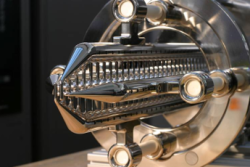 We have developed a unique molecular collision experiment in which perfect control is obtained over the molecules before the collision using decelerators, and velocity map imaging is used to probe the molecules afterwards. This combination of techniques allows us to study collisions as a function of energy, and to visualize how molecular scattering processes evolve from classical mechanics at high energies to the pure quantum regime at temperatures down to 0.1 Kelvin.
This reveals the fundamental physics underlying the scattering process that originates from the wave-character of the molecules, such as diffraction of matter waves, quantum tunneling, and even the quantization of the relative motion between the colliding molecules.
(Photo: The Nijmegen Stark decelerator: the 2.6-meter-long structure consists of 316 pairs of polished stainless steel electrodes, and is used to prepare a packet of molecules prior to the collision. Credit: Ludwig Scharfenberg)
-
-
12:30 - 13:45
-
Lunch break and FYSICA market
-
Challenge World Champion Jan Groenendijk in a speed checkers contest! + lunch
More information
Are you one of the maximum of 25 challengers of Jan Groenendijk? Register quickly! Of course there will be lunch as well, it is available in the central hall, close to the checkers contest.
-
General Meeting of the NNV (ALV, members only) + lunch
More information
During the ALV we will discuss developments at our society, present the financial and board reports of 2025. A highlight will be the announcement of the future president of the NNV, who is chosen in a members' election in March.
Documents for this meeting will be published on the NNV website at a later moment.
Lunch will be available.
-
SPIN Bachelor Contest + lunch
More information
Lunch is provided for all participants, supporters and other attendants of this contest organized by SPIN, in which three students present their bachelor research. The winner will be announced later in the day.
-
-
13:45 - 15:05
-
Focus session HEF/ASTRO Future of big science
-
Focus session Sustainability
More information
Information to follow
-
Students' focus session
-
Excursion to the Maelwael Van Lymborch House
More information
In the Maelwael Van Lymborch House you will go on a journey through the exciting story of Herman, Paul and Johan van Lymborch, whose paintings garnered worldwide fame. Enjoy the brilliant art of the 'Rembrandts of the Middle Ages'and experience history in the authentic cellar of their 14th century workshop.
A bus will depart from De Vasim to transport you to the museum and back.
-
History and Foundations
-
-
15:05 - 15:10
-
Break to switch to next focus session or excursion
-
-
15:10 - 16:30
-
Focus session Instutute of Molecules and Materials en High Field Magnet Laboratory
More information
In this focus session the exciting research of the RU's Instutute of Molecules and Materials en High Field Magnet Laboratory will be discussed. More information to follow.
-
Education: from research to school exams
More information
Exam writers are regularly inspired by current scientific research. It is a challenge to translate and simplify this research into a problem that students can solve. During this educational session, exam writers are happy to take you along on the long (journey of discovery) from a scientific publication to a problem for a physics final exam.
More information to follow.
-
Session Diversity/Inclusion - What is wrong with me?
More information
Why are sexism, homophobia and racism still so prevalent in physics?
CERN, the largest physics laboratory in the world, welcomes scientists from 112 nationalities but still about 80% of them are white and 80% are male. Starting from her personal experience and aiming to demonstrate that in fact the personal is political, Dr. Pauline Gagnon examines why people from so many various groups have been historically excluded from physics and suggests a series of measures that could greatly improve diversity in physics.
Pauline Gagnon, retired Senior Research Scientist, completed her PhD in particle physics at University of California in Santa Cruz. Her research activities were mostly based at CERN, the European Laboratory for Particle Physics located near Geneva, where she worked as a Senior Research Scientist with Indiana University. She participated in the discovery of the Higgs boson in 2012 and looked for dark matter within the ATLAS experiment. After 2011 she joined the CERN Communication group, writing blogs and answering questions from numerous media worldwide. Explaining particle physics in simple and accessible terms became her trademark and in 2014 she wrote a popular science book called "Who cares about particle physics: Making sense of the Higgs boson, the Large Hadron Collider and CERN", which is also available in seven other languages. Since retiring she has given more than two hundred presentations to various audiences in fourteen countries, talking about physics and diversity issues.
-
Excursion to...
-
Student focus session 2
-
-
16:30 - 17:00
-
Tea break and FYSICA market
-
-
17:00 - 17:15
-
Award ceremonies NTvN, SPIN Bachelor Project Contest and Young Speakers Contest
-
-
17:15 - 17:50
-
Physics Nobel Prize Lecture - Hans Hilgenkamp
-
-
17:50 - 18:00
-
Closing ceremony
-
-
18:00 - 20:00
-
Drinks and dinner
-